
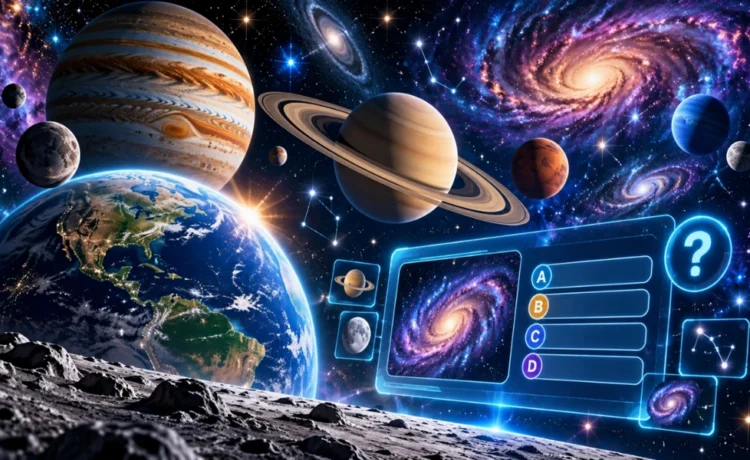
The universe has fascinated humanity for thousands of years. From ancient civilizations studying the movements of stars to modern astronomers examining distant galaxies, our curiosity about space continues to inspire discoveries. Astronomy introduces us to remarkable subjects, including planetary systems, black holes, nebulae, and the possibility of life beyond Earth. However, understanding these concepts can sometimes feel overwhelming, especially for beginners. Interactive space quizzes offer an enjoyable and accessible way to explore astronomy while turning complex scientific ideas into memorable learning experiences.
One of the most appealing aspects of astronomy quizzes is their ability to transform scientific knowledge into an interactive challenge. Rather than simply reading facts about planets and stars, learners can answer questions, analyze images, and discover explanations behind fascinating cosmic phenomena. Educational platforms offering bing quizzes provide opportunities to explore different subjects through question-based activities. When astronomy becomes part of a regular trivia routine, learners can gradually strengthen their understanding of the solar system, space exploration, and the wider universe without feeling pressured by traditional examinations.
Unlike passive learning methods, interactive quizzes encourage people to retrieve information from memory. Imagine answering a question about why Venus is hotter than Mercury despite being farther from the Sun. A learner might initially assume that the closest planet must be the hottest. Discovering that Venus has an extremely dense atmosphere that traps heat helps correct this misconception. This process of questioning, reasoning, and reviewing explanations can make scientific knowledge more meaningful and easier to remember.
Short, accessible trivia activities can also help develop consistent learning habits. Someone who spends a few minutes each morning answering questions may gradually build a broader understanding of astronomy alongside geography, history, and other subjects. Resources such as the bing daily trivia & featured image quiz offer another way to make curiosity part of an everyday routine. Featured images can provide a visual starting point for exploration, encouraging learners to investigate unfamiliar landscapes, celestial objects, or scientific concepts.
Astronomy is especially well suited to visual and question-based learning because many of its most fascinating ideas involve objects that cannot be examined directly in everyday life. Consider the enormous distances between stars. A light-year is not a measurement of time but the distance light travels in one year, approximately 9.46 trillion kilometers. By introducing this concept through a question and then explaining the answer, a quiz can help learners understand why astronomers need specialized units to describe distances across the universe.
The educational potential of astronomy quizzes is also reflected in academic science communication. In May 2025, the Harvard Gazette published an astronomy research-based quiz titled Strange Galactic Facts, developed with input from a researcher affiliated with the Center for Astrophysics | Harvard & Smithsonian. The quiz explores galaxies and unanswered scientific questions, demonstrating how research institutions can use interactive questions to introduce complex astronomical topics to a wider audience. Such initiatives show that quizzes can serve as more than entertainment: they can connect public curiosity with genuine scientific inquiry.
Why Astronomy Is an Ideal Subject for Interactive Learning
Astronomy combines observation, mathematics, physics, chemistry, and history. Understanding celestial objects often requires learners to connect several scientific ideas rather than memorize isolated facts.
For example, learning about the Sun introduces the concept of nuclear fusion. Studying planetary orbits creates opportunities to understand gravity. Exploring distant galaxies reveals how scientists use light to investigate events that occurred millions or billions of years ago.
Interactive quizzes can make these connections easier to recognize.
A question about the blue appearance of Neptune might lead to an explanation of how methane in its atmosphere absorbs certain wavelengths of sunlight. Similarly, a question about Saturn’s rings can introduce the concept of countless particles of ice and rocky material orbiting a planet.
The educational value lies not only in selecting the correct answer but also in understanding the scientific principles behind it.
Discovering the Solar System One Question at a Time
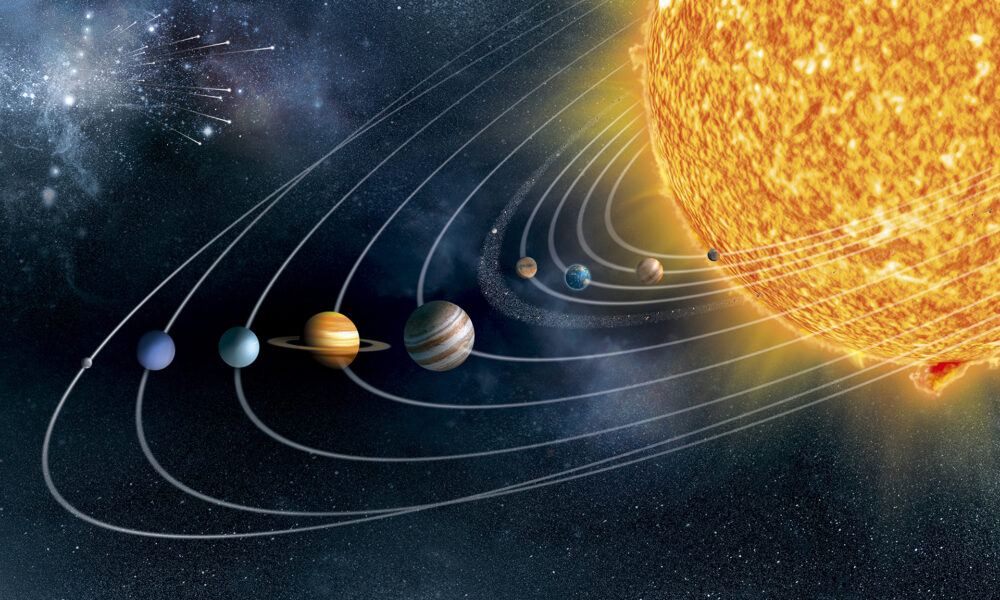
Our solar system provides an excellent starting point for astronomy beginners because its planets, moons, asteroids, and comets offer an enormous variety of learning opportunities.
A well-designed solar system quiz can explore several important concepts:
- Planetary characteristics: Comparing rocky planets such as Earth and Mars with gas giants such as Jupiter and Saturn.
- Orbital motion: Understanding why planets revolve around the Sun and why their orbital periods differ.
- Planetary atmospheres: Exploring how atmospheric composition affects temperature and weather.
- Natural satellites: Learning about Earth’s Moon, Jupiter’s Europa, and Saturn’s Titan.
- Small celestial bodies: Identifying the differences between asteroids, comets, meteoroids, meteors, and meteorites.
These subjects become particularly engaging when accompanied by visual comparisons.
For example, a question asking learners to identify Jupiter from an image can encourage them to recognize its distinctive cloud bands and Great Red Spot.
An additional explanation might reveal that the Great Red Spot is a long-lived atmospheric storm, introducing basic concepts of planetary weather.
By combining observation with scientific reasoning, astronomy quizzes teach learners how to interpret information rather than simply memorize names.
Understanding Stars, Galaxies, and the Universe
Beyond the solar system lies an extraordinary collection of stars, nebulae, galaxies, and other cosmic structures.
Understanding the relationships between these objects is essential for developing a clear picture of the universe.
Stars and their life cycles
Stars form when regions of dense gas within molecular clouds collapse under gravity. As the central temperature and pressure increase, nuclear fusion can begin, producing the energy that makes stars shine.
A quiz about stellar evolution might ask:
What determines how a star will evolve and eventually die?
The most important factor is its initial mass.
Lower-mass stars, including the Sun, are expected to end their lives as white dwarfs after passing through later stages of stellar evolution. Much more massive stars may undergo core-collapse supernovae, leaving behind neutron stars or black holes.
An explanation like this transforms a simple question into a useful introduction to astrophysics.
Galaxies and their structures
Galaxies are enormous gravitationally bound systems containing stars, gas, dust, and dark matter.
Astronomers commonly classify them according to their observable shapes, including spiral, elliptical, lenticular, and irregular galaxies.
Our own Milky Way is a barred spiral galaxy, and the Sun is located within its disk, far from the galactic center.
Image-based questions about galaxy shapes allow learners to practice scientific classification while becoming familiar with the universe’s large-scale structures.
Black holes and cosmic mysteries
Few astronomical subjects capture public imagination as strongly as black holes.
These objects contain regions where gravity is so intense that light cannot escape from within the event horizon.
A useful quiz can distinguish scientific explanations from popular misconceptions, such as the idea that black holes automatically pull in everything around them regardless of distance.
In reality, objects can orbit a black hole just as they can orbit other massive bodies, provided their trajectories remain outside regions where capture becomes unavoidable.
Learning these distinctions encourages critical thinking and a more accurate understanding of modern physics.
How Interactive Space Quizzes Support Knowledge Retention
Educational quizzes become especially useful when they incorporate principles associated with effective learning.
1. Active recall
Active recall involves retrieving information from memory without immediately consulting the answer.
Instead of rereading a paragraph about Mars, a learner might answer a question about why the planet appears reddish.
Attempting to remember that iron-bearing minerals contribute to its reddish surface appearance strengthens engagement with the underlying concept.
2. Immediate feedback
Feedback helps learners identify misconceptions before those misunderstandings become deeply established.
For example, if someone mistakenly believes that Earth’s seasons are caused primarily by changes in its distance from the Sun, a quiz can explain that Earth’s axial tilt is the main reason for seasonal variations.
Explanations are particularly valuable because knowing why an answer is correct provides deeper understanding than receiving a score alone.
3. Spaced repetition
Reviewing information across multiple learning sessions can help support longer-term retention.
An astronomy learner might study planetary characteristics on Monday, revisit them on Thursday, and answer related questions the following week.
This approach is generally more effective for durable learning than relying exclusively on a single intensive study session.
4. Visual recognition
Astronomy offers remarkable opportunities to learn through photographs, telescope images, diagrams, and illustrations.
Recognizing Jupiter’s cloud bands, the rings of Saturn, or the spiral structure of a galaxy can help learners connect visual evidence with scientific descriptions.
However, educators should identify artist’s impressions clearly so learners do not confuse illustrations with actual observational images.
A Mini Astronomy Quiz to Test Your Knowledge
Try answering these five questions before reading the explanations.
Question 1: Which planet has the highest average surface temperature in our solar system?
A. Mercury
B. Venus
C. Mars
D. Jupiter
Correct answer: B. Venus.
Venus has a dense carbon dioxide atmosphere that produces an intense greenhouse effect. Its average surface temperature is approximately 465°C, making it hotter than Mercury.
Question 2: What is the main source of the Sun’s energy?
A. Burning oxygen
B. Radioactive decay
C. Nuclear fusion
D. Friction between gases
Correct answer: C. Nuclear fusion.
In the Sun’s core, hydrogen nuclei fuse through a sequence of nuclear reactions that ultimately produce helium and release energy.
Question 3: What causes the phases of the Moon?
A. Earth’s shadow covering the Moon every month
B. Changes in the Moon’s physical shape
C. Changes in the visible portion of the Moon’s sunlit half
D. Clouds passing between Earth and the Moon
Correct answer: C. Changes in the visible portion of the Moon’s sunlit half.
As the Moon orbits Earth, our viewing angle changes, revealing different amounts of its illuminated hemisphere. Earth’s shadow is responsible for lunar eclipses, not ordinary lunar phases.
Question 4: Which galaxy contains our solar system?
A. Andromeda Galaxy
B. Triangulum Galaxy
C. Whirlpool Galaxy
D. Milky Way Galaxy
Correct answer: D. Milky Way Galaxy.
The Milky Way contains our Sun and billions of other stars. The solar system lies within its galactic disk.
Question 5: What does a light-year measure?
A. Time
B. Distance
C. Brightness
D. Temperature
Correct answer: B. Distance.
A light-year describes how far light travels through a vacuum during one year. Astronomers use this unit to communicate vast cosmic distances.
The purpose of these questions is not simply to achieve a perfect score. Each explanation provides another opportunity to clarify concepts and build scientific understanding.
Using Astronomy Quizzes in Classrooms and Independent Study
Teachers can incorporate interactive space quizzes into different stages of a lesson.
At the beginning, a short quiz can reveal what students already know about the subject. During instruction, carefully selected questions can reinforce new concepts. After the lesson, a review quiz can help determine which topics require further explanation.
For example, a teacher introducing planetary motion might begin with questions about the order of the planets. Once students understand the basic structure of the solar system, the quiz can progress toward more challenging ideas involving gravity, orbital periods, and planetary rotation.
Independent learners can follow a similar approach by setting manageable weekly goals.
One week might focus on the solar system, while another examines stellar evolution or space exploration.
Keeping a record of unfamiliar questions and revisiting them periodically can turn casual trivia participation into a structured educational activity.
Building Better Astronomy Quizzes
Not all quizzes offer the same educational benefits. An effective astronomy quiz should encourage understanding rather than reward guesswork alone.
Strong quiz design generally includes accurate scientific information, clear language, plausible answer choices, and explanations that address common misconceptions.
Questions should also vary in difficulty.
Beginners might identify planets using recognizable images, while intermediate learners could compare planetary atmospheres. Advanced questions might introduce redshift, gravitational lensing, spectroscopy, or the relationship between stellar mass and luminosity.
Visual questions should use sufficiently clear images and identify when size, color, or distance has been modified for illustration.
It is equally important to distinguish established scientific findings from hypotheses and ongoing research. Astronomy continues to evolve, and some questions do not yet have definitive answers.
Good quizzes can encourage curiosity about these uncertainties rather than present scientific knowledge as a collection of permanently settled facts.
Connecting Space Quizzes With Real-World Observation
One of the greatest advantages of astronomy education is that learners can connect digital activities with observations of the real sky.
After completing a quiz about lunar phases, students can observe the Moon across several evenings and record changes in its appearance.
Following a lesson about constellations, learners can use a sky map or astronomy application to identify prominent star patterns visible from their location.
Questions about planets can inspire comparisons between how Venus, Jupiter, and Saturn appear through binoculars or a telescope, when observing conditions permit.
These activities turn abstract knowledge into direct experience.
They also encourage students to appreciate an essential part of scientific practice: developing a question, gathering observations, and using evidence to evaluate explanations.
The Future of Interactive Astronomy Education
As educational technology continues to develop, astronomy quizzes may become increasingly immersive and personalized.
Interactive three-dimensional solar system models can help students visualize orbital motion. Virtual planetariums can recreate the night sky from different locations. Adaptive quizzes can adjust question difficulty based on a learner’s progress.
These technologies can complement traditional textbooks and classroom discussions, particularly when they provide scientifically reliable explanations and opportunities to test understanding.
Nevertheless, sophisticated technology is not a requirement for meaningful learning.
Even a straightforward multiple-choice quiz can encourage curiosity, reveal knowledge gaps, and inspire someone to investigate an unfamiliar astronomical concept.
The most important ingredient is thoughtful educational design that rewards reasoning and exploration.
Conclusion: Turning Cosmic Curiosity Into Lifelong Learning
Astronomy reminds us that Earth is part of a universe filled with extraordinary objects, complex physical processes, and unanswered questions.
Interactive space quizzes make this vast subject more approachable by breaking difficult concepts into manageable learning experiences. Through active recall, meaningful feedback, visual recognition, and repeated practice, learners can gradually develop stronger scientific literacy.
Whether someone is identifying the planets for the first time or exploring advanced ideas about black holes and distant galaxies, astronomy quizzes offer a practical way to learn while remaining curious.
Every question is an invitation to discover something new about the universe. A simple quiz about the night sky may become the first step toward a deeper appreciation of science, observation, and the remarkable world beyond our planet.